| Hydrogen Overview

Hydrogen is the first element in the periodic table. It is the lightest chemical element, consisting of one proton and one electron, and it is stable in the form of a molecule made up of two atoms (H2).

Hydrogen is not a direct source of energy but rather an energy vector or carrier, as it stores energy and facilitates its transport, distribution, and use.

Hydrogen is rarely found in its pure form in nature; it is typically combined with elements like oxygen and carbon, so a separation process is needed to extract it.

Hydrogen is energy-rich; its energy value is higher than that of traditional fuels. However, its density is very low.
| Hydrogen colors
Haz clic en un color para conocer más sobre el hidrógeno
Green Hydrogen
Green hydrogen is produced primarily by splitting water (i.e., electrolysis of water) using electricity generated from non-conventional renewable energy sources (NCRE).
Technology: Electrolysis
Energy source: Solar, wind power, biomass, geothermal, others.
Direct Emissions: 0,6-1,4 kg CO2eq./kgH2***
Green hydrogen production is regarded as a zero-carbon dioxide emission process in terms of direct emissions. However, when considering the life cycle emissions from renewable energy sources (RES) like hydroelectric, wind, and solar photovoltaic, there is an associated environmental impact. In addition, to accurately assess the environmental impact of green hydrogen, it is necessary to consider the emissions throughout the supply chain. CO2 emissions vary from 0.7 to 2.8 kg CO2eq./kgH2 when the whole supply chain is factored in.
SourcesWhite Hydrogen
White hydrogen is naturally occurring hydrogen associated with geological processes in the Earth's crust. It exists in its natural state as free gas in various geological environments, including continental crust layers, oceanic crust, volcanic gases, and hydrothermal systems such as geysers. It is considered a Non-Conventional Renewable Energy Source (FNCER).
Technology: Exploratory drilling and production through shallow or conventional wells, depending on the reservoir depth.
Energy source: Natural Geological Processes.
Direct Emissions: 0.37–1.50 kg CO₂eq/kg H₂.
Its environmental impact is significantly lower than other types of hydrogen, as its production does not require energy-intensive industrial processes. Direct emissions are virtually negligible, although fugitive emissions of hydrogen, methane, and nitrogen may occur during drilling and extraction.
Indirect emissions originate from energy use in hydrogen collection, compression, storage, and transportation. However, these can be minimized through the use of renewable energy sources and gas capture technologies.
SourcesPink or violet Hydrogen
These two colors are linked to processes that produce the highest levels of carbon dioxide emissions.
Technology: Electrolysis
Energy source: Nuclear
Direct Emissions: 0,3-0,6 kgCO2eq/ kgH2*
*While it does not produce direct carbon emissions, it poses other significant environmental risks, including radiation, waste management challenges, and the potential for accidents.
SourcesBlack / Brown Hydrogen
Hydrogen produced from coal is categorized by color: black for bituminous coal and brown for lignite. Coal gasification is the method used to produce hydrogen from these types of coal. However, it is a highly polluting process, with CO2 and carbon monoxide released into the atmosphere as by-products.
Technology: Gasification
Energy source: Black (Coal)/brown (lignite)
Direct Emissions: 18-25 kgCO2eq/kgH2*
These two colors are linked to processes that produce the highest levels of carbon dioxide emissions.
SourcesYellow Hydrogen
While it does not produce direct carbon emissions, it poses other significant environmental risks, including radiation, waste management challenges, and the potential for accidents.
Technology: Electrolysis
Energy source: Mixed-source – power grid with mix origin
Direct Emissions:
Emission intensities for hydrogen are also related to the emission intensity of the power grid. To keep hydrogen production emissions at or below 2 kg CO2-eq per kg of H2, the emission intensity of grid electricity needs to be 40 g CO2-eq per kWh or less.*
SourcesBlue Hydrogen
Blue hydrogen is produced from natural gas using the steam methane reforming (SMR) method. Unlike gray hydrogen, most (though not all) of the CO2 emitted during the process is captured and either stored underground (carbon sequestration) or utilized in the production process. This is known as carbon capture, storage and utilization (CCUS).
Technology: Steam methane reforming(SMR) + CCUS
Energy source: Natural gas, coal.
Direct Emissions: 0.8-4.8 kgCO2 eq/kgH2*
The carbon intensity of blue hydrogen may vary depending on the technology used and the percentage of CCUS applied.
SourcesTurquoise Hydrogen
Extracted through the thermal splitting (pyrolysis) of natural gas, this process produces carbon in solid form instead of CO2 gas.
Technology: Pyrolisis
Energy source: Natural gas.
Direct Emissions: 1.9–4.8 kgCO2eq/kgH2*.
This technology is now the subject of extensive research because its solid carbon by-product eliminates the need for Carbon Capture, Utilization, and Storage (CCUS).
SourcesGray Hydrogen
Gray hydrogen is produced from natural gas using the steam methane reforming (SMR) method. During this process, CO2 is generated and eventually released into the atmosphere.
Technology: Steam methane reforming(SMR)
Energy source: Natural gas.
Direct Emissions: 7,5-13 kgCO2eq/kgH2*
The carbon intensity of gray hydrogen depends on the emissions along the methane value chain, including upstream and fugitive emissions.
Sources| Emission-based hydrogen classification
Using colors to label specific production routes or terms like 'green' or 'renewable,' 'low carbon,' or 'clean hydrogen' can obscure the varying levels of potential emissions. Therefore, the Ministry of Mines and Energy and the Ministry of Environment and Sustainable Development are working to set a threshold for emissions intensity in hydrogen production. This aims to define national regulations and enhance interoperability with both domestic and international markets. "Furthermore, it is essential to assess the impacts on both the production and use of hydrogen and its derivatives.
Chart 1. Resumen de mecanismos voluntarios con criterios técnicos publicados
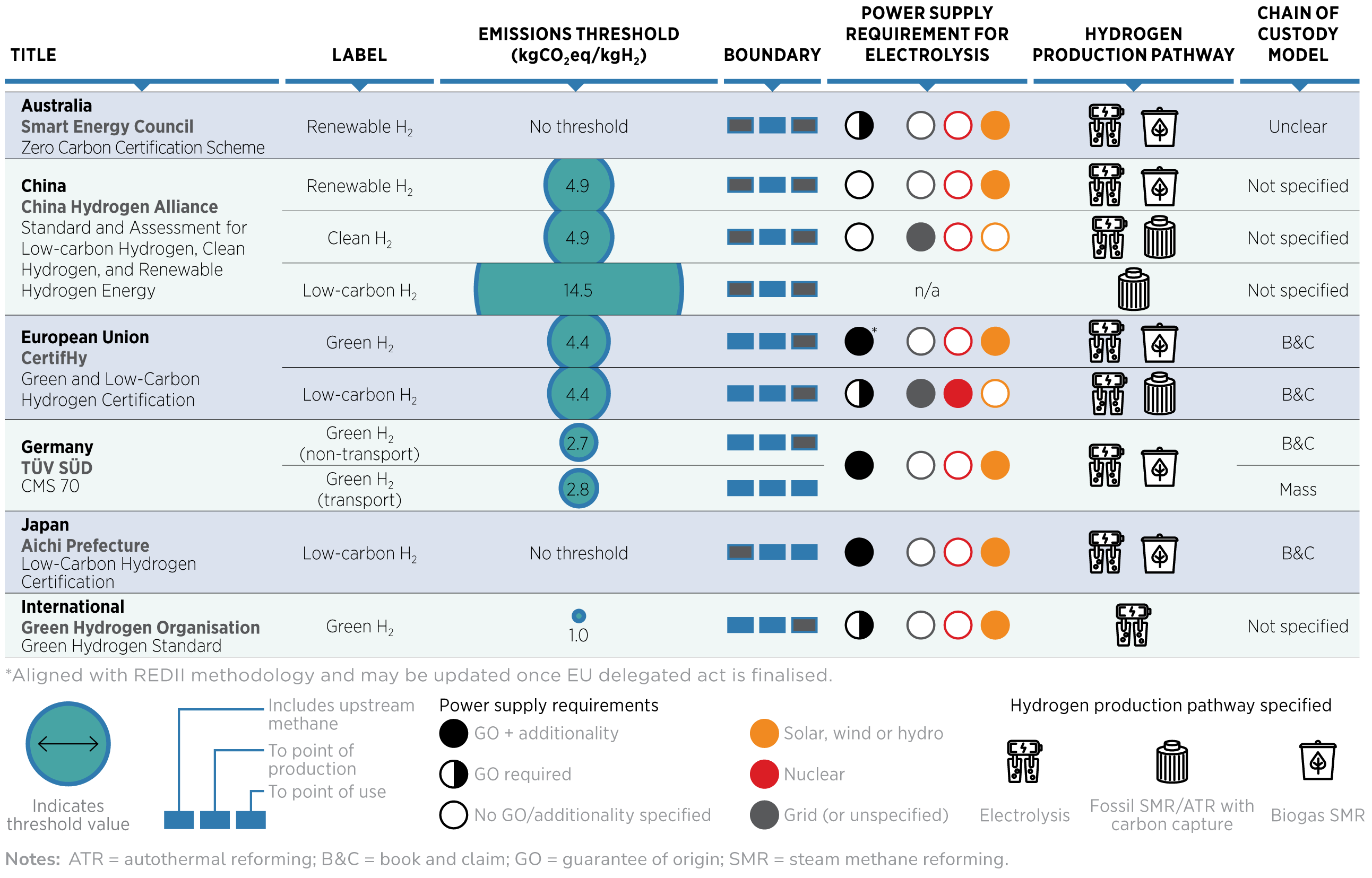
Fuente: IRENA and RMI (2023), Creating a global hydrogen market: Certification to enable trade, International Renewable Energy Agency, Abu Dhabi; and RMI, Colorado.
Chart 2. Resumen de mecanismos obligatorios con criterios técnicos publicados

Fuente: IRENA and RMI (2023), Creating a global hydrogen market: Certification to enable trade, International Renewable Energy Agency, Abu Dhabi; and RMI, Colorado.
| Testimonials

As part of our efforts to boost hydrogen deployment nationwide, the Ministry of Mines and Energy has launched a comprehensive information management system to provide actors across the value chain with all necessary information, including technology, personnel and industry trends, while systematically managing information on the current state of the industry.
Andrés Camacho Morales, Former minister
Ministry of Mines and Energy
"Hydrogen represents a tremendous opportunity for Colombia. It is a key element in addressing three major challenges facing the country: decarbonization, energy transition, and economic diversification"
Karen Peralta, Director
Hydrogen Chamber of the Colombian Business Association - Naturgas
"Colombia is resolutely devoted to combating climate change. Since 2014, the nation has been at the forefront of building an ecosystem that champions clean technologies and drives the energy transition forward".
The next step in this mission is hydrogen and its derivatives. With its immense potential, Colombia is poised to harness this transformative energy vector to decarbonize energy-intensive industries and emerge as a leading global exporter in the field.
Mónica Gasca, President
Colombian Hydrogen Association
"The Colombian-German business community is committed to the decarbonization of industries and recognizes a significant opportunity to contribute German technology and expertise to the development of the hydrogen economy and its derivatives in Colombia. United, we are paving the way to a brighter, more sustainable future".
Mischa Groh, Chief Executive Officer
German-Colombian Chamber of Industry and Commerce (AHK)
Green hydrogen is a pivotal energy vector in the global transition, offering decarbonization solutions for sectors that are difficult to electrify directly, such as fertilizer production, steel manufacturing, and synthetic fuels for shipping and aviation. Countries with abundant renewable energy resources, like Colombia, have a unique opportunity to develop new value chains for green hydrogen derivatives, including ammonia, methanol, and aviation fuel. These developments promise to bolster the local economy and hold substantial potential for international commercialization. To unlock this potential, it is crucial to establish robust enabling frameworks, which should encompass infrastructure development, technical expertise, and regulations that promote demand for these renewable energy-based products”.
Francisco Boshell, Head Innovation and End Use Applications
IRENA
“Germany and Colombia share a strong commitment for climate protection. For this reason we have signed a Climate and Just Energy Transition Partnership, in which green hydrogen and its derivatives play a key role. Through decarbonization and diversification we create climate-neutral value chains that contribute to closing environmental, social and economic gaps’.
Martina Klumpp, German Ambassador to Colombia
Federal Republic of Germany
Latin America and the Caribbean, with Colombia at the forefront, have a historic opportunity to lead the hydrogen revolution, turning this energy vector into the cornerstone of sustainable and inclusive development. By fostering productive linkages that strengthen our local industries, we will drive more resilient and competitive economies. This effort will not only promote robust economic growth but also ensure a social approach focused on generating quality jobs and developing communities. Moreover, by prioritizing environmental stewardship, we are building a legacy of sustainability that will protect our natural resources for future generations, solidifying an economic model that harmonizes social and environmental well-being.
Juan Zapata, leader of hydrogen group
Ministry of Mines and Energy
"In promoting the development of the green hydrogen sector in Colombia, we are mobilizing political dialogue, market instruments, and technical and financial cooperation tools that we have available from the European Union within the framework of Global Gateway. We deeply believe in the transformative potential of green hydrogen in driving a green and just transition, and we will continue working to strengthen this partnership."
Alberto Menghini, Head of Cooperation of the European Union Delegation in Colombia
European Union
Chemistry is to fuels what genetics is to living systems. Moreover, the social appropriation of knowledge, along with safety and economies of scope, can enable Colombia to develop its PtX potential competitively.
Andrés Amell, Coordinator of the Gasure Research Group
University of Antioquia

| H2 Colombia Associations

Projects
Register your project and learn more about current hydrogen projects in Colombia.
Read more