| EXPLOITATION
Direct Exploitation
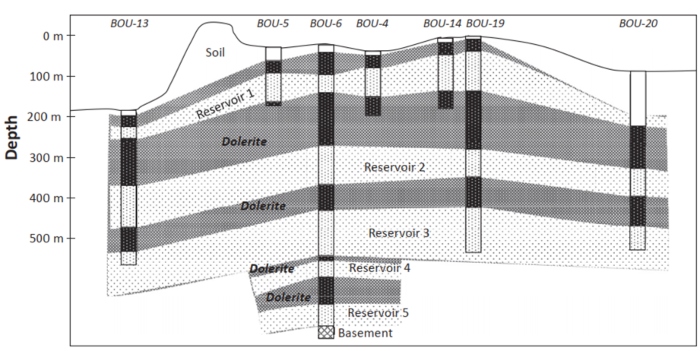 1. Schematic cross - section of the Bourakébougou gas field , which crosses several wells described in this study.
Source: (NASA, 2023).
1. Schematic cross - section of the Bourakébougou gas field , which crosses several wells described in this study.
Source: (NASA, 2023).
Extraction of geological hydrogen accumulated naturally in the subsoil, generated by natural processes and retained in reservoirs sealed by impermeable formations, in a manner analogous to oil or natural gas.
Key Geological Factors
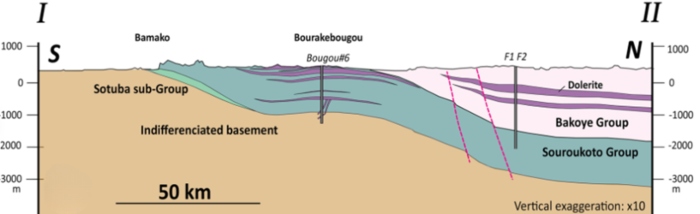 Geological cross - section of potentially hydrogen-generating formations at varying depths. The Bougou#6 well intersects iron-rich rocks at shallow depths.
Source: (Maiga et al., 2023).
Geological cross - section of potentially hydrogen-generating formations at varying depths. The Bougou#6 well intersects iron-rich rocks at shallow depths.
Source: (Maiga et al., 2023).
Source rocks must be located at shallow depths to allow for economically viable drilling. Depth directly impacts costs and flow rates.
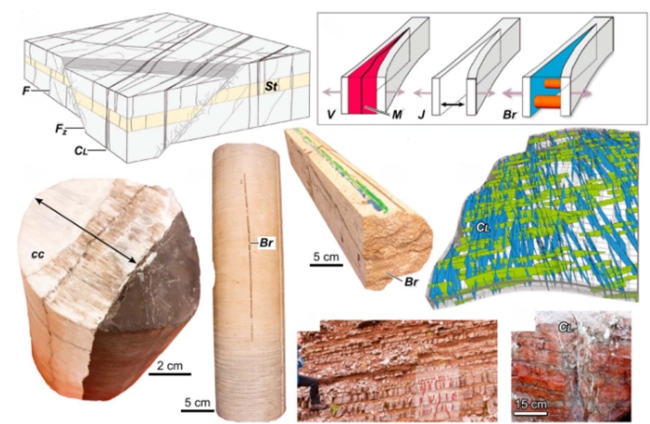 Types of Fractures.
Source: (Laubach et al., 2019).
Types of Fractures.
Source: (Laubach et al., 2019).
The presence of interconnected fractures is essential to release the hydrogen generated in the rock matrix and facilitate its migration to the well.
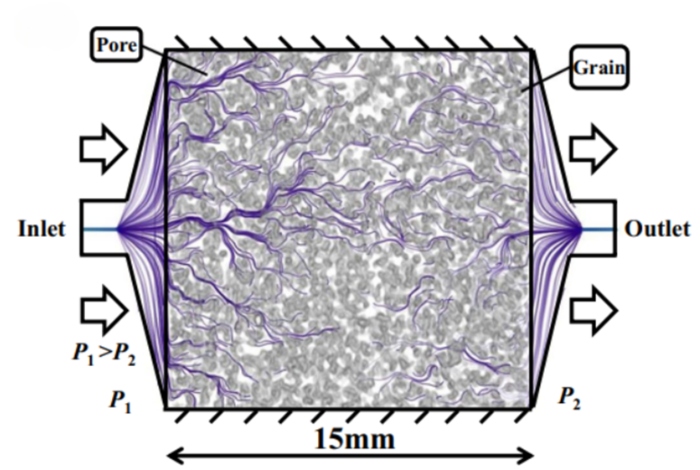 Simulation of fluid flow in a porous medium with high pore connectivity.
Source: (Zhao et al., 2019).
Simulation of fluid flow in a porous medium with high pore connectivity.
Source: (Zhao et al., 2019).
Good permeability ensures efficient hydrogen flow to the well. Reservoirs with low permeability can produce high-purity gas but at very low rates.
Infrastructure and Equipment
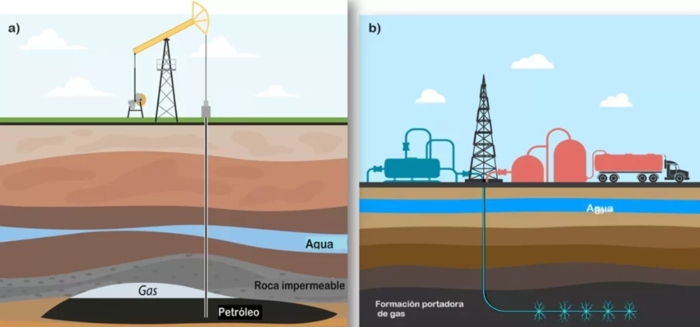 Gas and oil drilling wells. a ) Conventional. b) Unconventional.
Source: (López, 2024).
Gas and oil drilling wells. a ) Conventional. b) Unconventional.
Source: (López, 2024).
Geological hydrogen exploitation can leverage technologies from the oil and gas industry, such as well drilling and completion. Although adjustments may be required due to its properties, existing infrastructure and experience provide a solid technical foundation , reducing costs and accelerating project development.
Stimulated Production
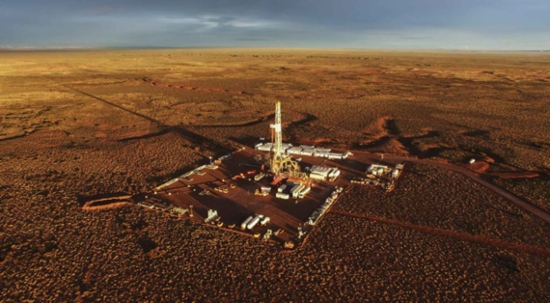 Aerial photo of hydraulic fracturing equipment, Patagonia.
Source: (Everts, 2024).
Aerial photo of hydraulic fracturing equipment, Patagonia.
Source: (Everts, 2024).
A set of techniques that increase hydrogen generation and/or recovery in iron-rich formations through active intervention; the co-injection of CO₂ facilitates its geological storage and contributes to climate change mitigation.
Stimulated Production Techniques
It accelerates the serpentinization of olivine, increases the release of Fe(II) and prevents its trapping in brucite, which improves hydrogen generation and allows simultaneous mineralization of CO₂ as magnesite.
It increases the temperature of the system, accelerating serpentinization reactions and overcoming kinetic barriers to hydrogen generation.
Catalysts such as nickel or platinum group metals (PGMs) reduce the temperature required to release hydrogen and improve the conversion efficiency of ferrous minerals.
Application of high-voltage electrical pulses to induce microfractures, expanding the reaction area between water and rock.
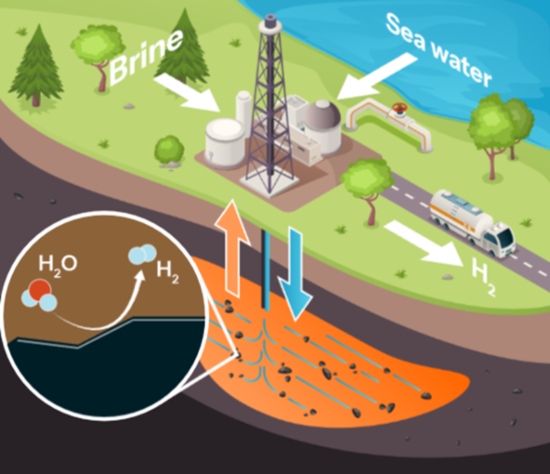 Schematic of stimulated geological hydrogen production by injecting saline or seawater into deep formations, where it reacts with subsurface minerals to release hydrogen in a controlled manner.
Source: (VEMA hydrogen).
Schematic of stimulated geological hydrogen production by injecting saline or seawater into deep formations, where it reacts with subsurface minerals to release hydrogen in a controlled manner.
Source: (VEMA hydrogen).
Using these techniques together could be key to optimizing hydrogen production and achieving commercial viability.
CO₂ Co-injection
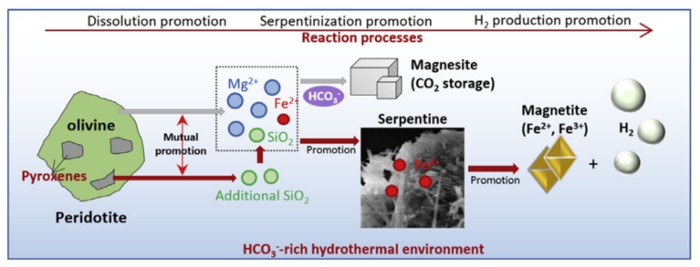 Schematic of the synergistic effect of CO₂ ( as HCO₃⁻ ) co-injection on olivine dissolution, serpentinization , and H₂ production , along with geological storage of carbon as magnesite.
Source: Wang et al. (2019c).
Schematic of the synergistic effect of CO₂ ( as HCO₃⁻ ) co-injection on olivine dissolution, serpentinization , and H₂ production , along with geological storage of carbon as magnesite.
Source: Wang et al. (2019c).
It promotes their mineralization as stable carbonates, reducing greenhouse gases, and at the same time accelerates hydrogen generation by releasing heat and reactive species that improve process efficiency.
Bibliographic References
- Everts, A. (2024). Everything you need to know about natural or geologic hydrogen. Hydrogen Science Coalition. Recuperado de - Check this reference here
- Laubach, S. E., Lander, R. H., Criscenti, L. J., Anovitz, L. M., Urai, J. L., Pollyea, R. M., Hooker, J. N., Narr, W., Evans, M. A., Kerisit, S. N., Olson, J. E., Dewers, T., Fisher, D., Bodnar, R., Evans, B., Dove, P., Bonnell, L. M., Marder, M. P., & Pyrak‐Nolte, L. (2019). The role of chemistry in fracture pattern development and opportunities to advance interpretations of geological materials. Reviews of Geophysics, 57(4), 1065–1111. - Check this reference here
- López, J. (2024). Tecnologías de monitoreo remoto para pozos de gas no convencionales. Recuperado el 14 de abril de 2025, de - Check this reference here
- Maiga, O., Deville, E., Laval, J., Prinzhofer, A., & Diallo, A. B. (2023). Characterization of the spontaneously recharging natural hydrogen reservoirs of Bourakebougou in Mali. Scientific Reports, 13, 11876. - Check this reference here
- Prinzhofer, A., Cissé, C. S. T., & Diallo, A. B. (2018). Discovery of a large accumulation of natural hydrogen in Bourakebougou (Mali). International Journal of Hydrogen Energy, 43(43), 19315–19326. - Check this reference here
- Vema Hydrogen. (s.f.). Stimulated Geologic Hydrogen. Recuperado el 14 de abril de 2025, de - Check this reference here
- Wang, J., Watanabe, N., Okamoto, A., Nakamura, K., & Komai, T. (2019a). Enhanced hydrogen production with carbon storage by olivine alteration in CO₂-rich hydrothermal environments. Journal of CO₂ Utilization, 30, 205–213. - Check this reference here
- Wang, J., Watanabe, N., Okamoto, A., Nakamura, K., & Komai, T. (2019b). Acceleration of hydrogen production during water-olivine-CO₂ reactions via high-temperature-facilitated Fe(II) release. International Journal of Hydrogen Energy, 44(22), 11514–11524. - Check this reference here
- Wang, J., Watanabe, N., Okamoto, A., Nakamura, K., & Komai, T. (2019c). Pyroxene control of H₂ production and carbon storage during water-peridotite-CO₂ hydrothermal reactions. International Journal of Hydrogen Energy. - Check this reference here
- Zhao, Y., Zhu, G., Liu, S., Wang, Y., & Zhang, C. (2019). Effects of pore structure on stress-dependent fluid flow in synthetic porous rocks using microfocus X-ray computed tomography. Transport in Porous Media, 128(3), 653–675. - Check this reference here