| Step by step

General requirements and incentives
- Incorporate your business
- Incentives
- Deducción en Renta
- VAT Exclusion
- Exención Arancelaria
- Accelerated Depreciation Deduction
- Incentives for Fuel Cell Vehicles

Land management
- Prior consultation
- ethnic or collective territories
- Archaeological Prospecting
- Project registration (UPME)
- Project overlap

Environmental requirements
- Legal considerations
- Projects that require an environmental license
- Projects that do not require an environmental license
General requirements and incentives
Incorporate your business
Incorporation through a public instrument executed before a notary or a private document, when the company has fewer than 10 employees or total assets of less than 500 times the minimum legal monthly wage (microenterprises) at the time of incorporation.
Register with the Chamber of Commerce Single Tax RegistryInvestment Opportunities and Favorable Policies
Favorable Policies
Colombia stands out in Latin America as a leader in public policies and regulations concerning hydrogen, currently:
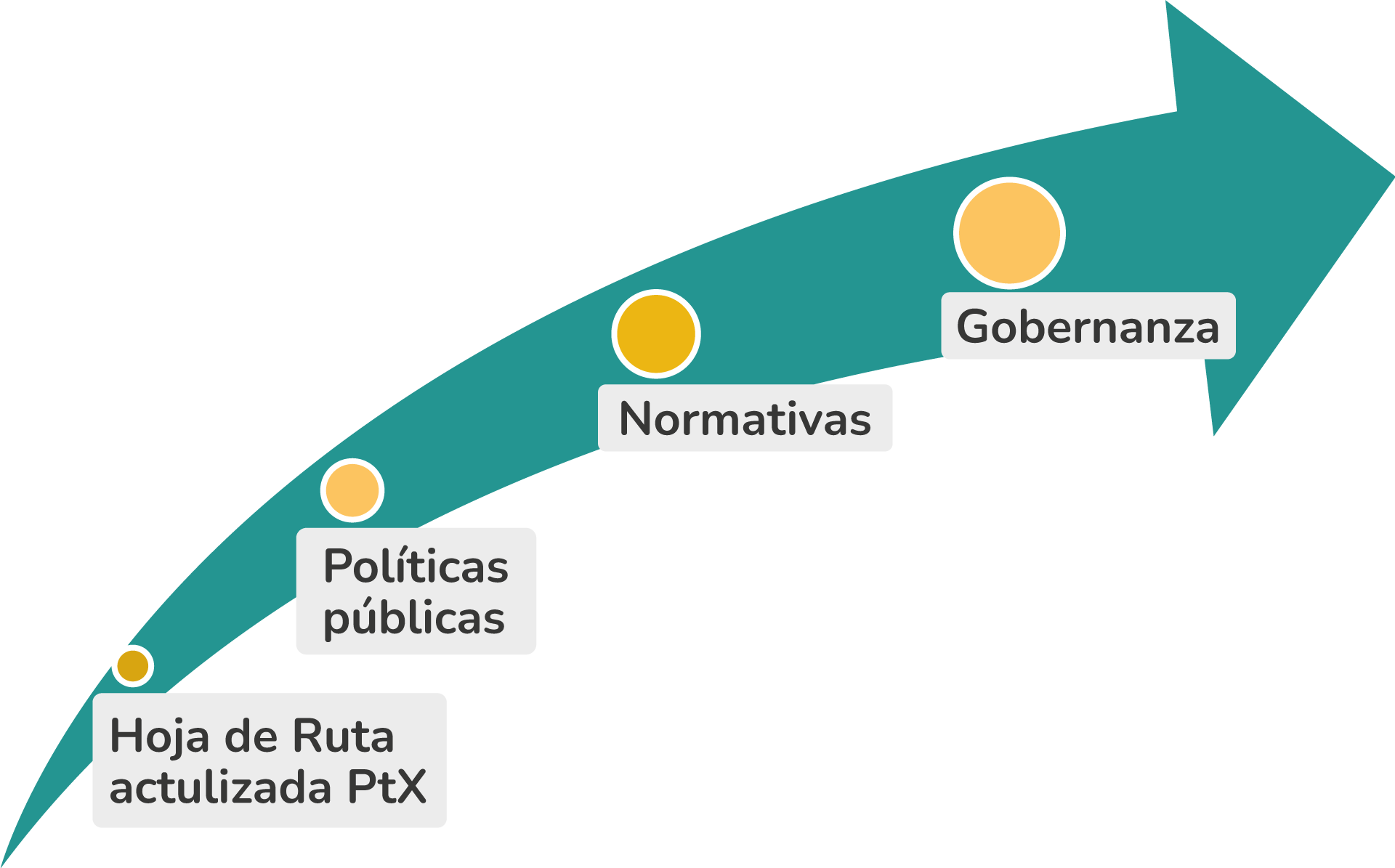
- A hydrogen roadmap, recognized as one of the pioneers in the region, with a groundbreaking international update on hydrogen derivatives such as ammonia, methanol, sustainable fuels, and synthetic natural gas. It sets national objectives for 2030, with targets for 2040 and 2050, all under a Just Energy Transition approach and sustainability criteria of the Power to X (PtX)-Hub Berlin, adapted to the national context.
- Public policies have been developed to elevate hydrogen as a cornerstone of the Just Energy Transition and the green reindustrialization of the country. In Colombia, green hydrogen is recognized as a key issue of public and social importance.
- A comprehensive set of studies, national strategies, and public policies aimed at harnessing the country's renewable energy potential. This includes initiatives such as a solar power surge (6 GW by 2026), energy communities to promote energy democratization, offshore wind energy, updating favorability maps for geothermal energy, sustainable aviation fuel (SAF), energy efficiency improvements in public buildings, green hydrogen production from biomass and small hydroelectric plants, geological hydrogen, bioenergy, and nuclear energy, among others.
- Pioneering regulations are shaping a legal and institutional framework that ensures investment security and the long-term sustainability of projects. This framework encompasses various aspects, including value chain regulations, guarantee of origin certification, technical standards, socio-environmental regulations, and climate finance, among others.
- Incentives for hydrogen generation are in place, and efforts are underway to develop additional incentives for the consumption of green hydrogen and its derivatives. This initiative reflects a national commitment to promoting the use of green fertilizers.
- Reevaluating the institutional framework to boost citizen engagement and support for especially protected groups presents significant challenges. This drive prompts Colombian administrations to modernize their approaches, ensuring the social, economic, and environmental sustainability of hydrogen as a key component of the Just Transition. The ultimate goal is to address and close the country’s historical gaps.
Tax, Financial, and Socio-environmental Benefits
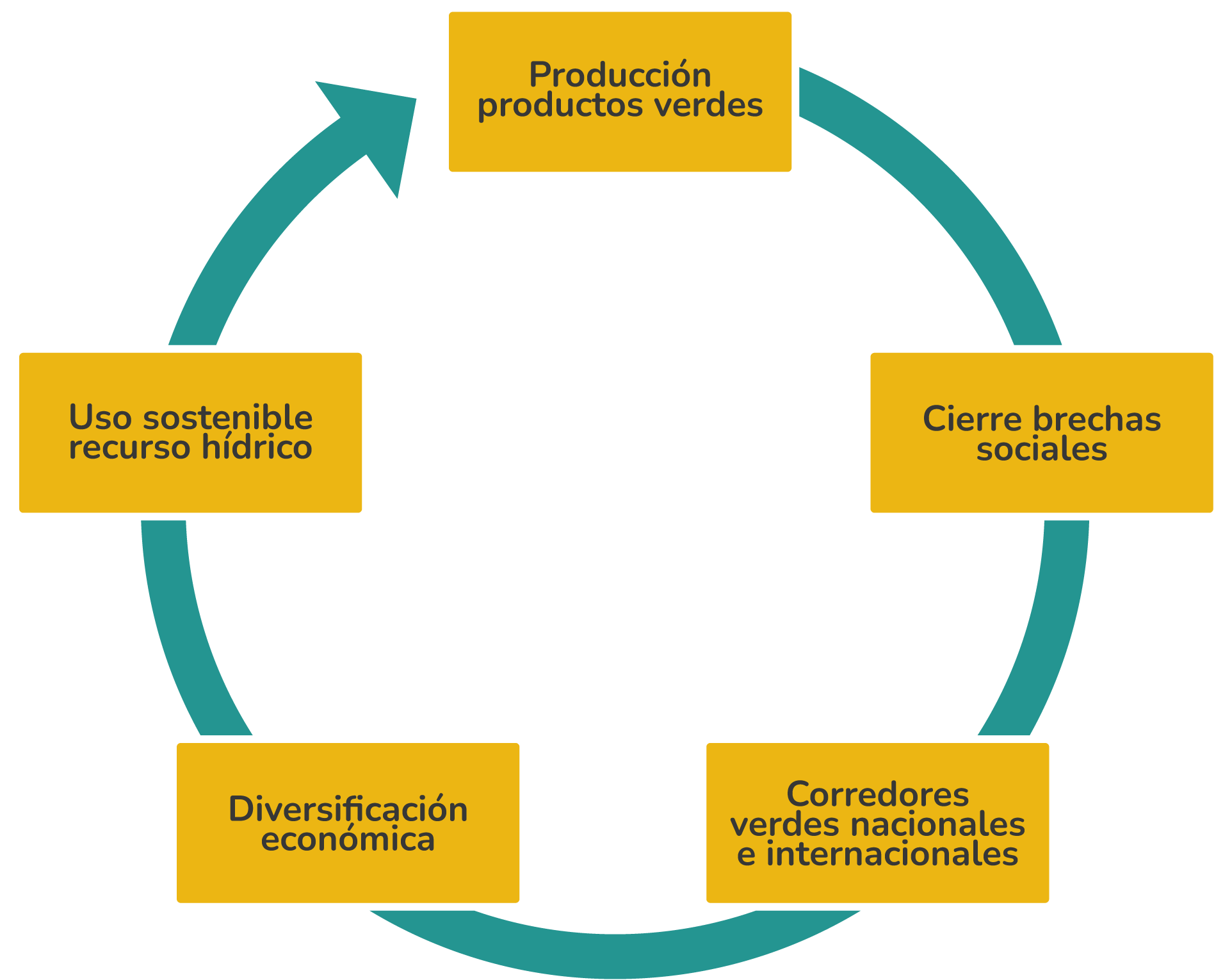
The Colombian State has a strong commitment to sustainability, highlighting environmental incentives:
- Substitution of Works for Taxes.
- Reduction in the consumption of water, energy, raw materials, and fuel; reduction in atmospheric emissions, discharges, and waste generation.
- Applicable to domestic or imported equipment with their respective control and monitoring systems.
- Impact of incentives on non-conventional energy sources in the transportation, industrial, tertiary, and residential sectors.
It is recommended that interested parties consult with the relevant authorities to access tax incentives, subject to compliance with Colombian regulations.
Financial Benefits
Tax incentives positively impact project capital costs (CAPEX)
Climate finance and green taxonomy
The large availability of renewable energy will allow the electrolyzer to operate more hours per year than the global average, combined with a decarbonized power grid
Development of social projects associated with green hydrogen (ESG criteria)
Access to key international and regional markets.
Environmental Benefits
Special Income Tax Deduction

Application
Benefit applicable to the development of research, development, and direct investment in green and blue hydrogen projects.

Condition
Requires certification requested by project participants and issued exclusively by UPME. The investment is evaluated as a green or blue hydrogen project.

Multiplicity of Investors
If there are multiple investors, each can access the benefit proportionally to their participation.

Benefit
Deduction of 50% of the total investment made from income tax for up to 15 years, starting from the tax year following the investment's entry into operation.
VAT Exclusion

Application
Benefit applicable to all services provided in Colombia or abroad, intended for the development of green and blue hydrogen projects. It applies to equipment, elements, machinery, and services, whether domestic or imported, required for the project.

Condition
Requires certification requested by project participants and issued exclusively by UPME. The investment is evaluated as a green or blue hydrogen project.

Benefit
Exclusion from VAT on the acquisition of goods and services for the development of green and blue hydrogen projects
Includes
Equipment, elements, machinery, and services, whether domestic or imported, intended for pre-investment and investment, for the production and use of energy from FNCE, as well as for the measurement and evaluation of potential resources to carry out actions and measures for the efficient energy management under the Rational and Efficient Energy Use Program (“PROURE”).
Tariff Exemption

Application
Applies to machinery, equipment, materials, and supplies exclusively intended for reinvestment and investment activities in the projects, which are not produced by the national industry and can only be acquired through importation.

Benefit
Exemption from paying import duties on machinery, equipment, materials, and supplies exclusively intended for reinvestment and investment activities in these projects.

Condition
The benefit must be requested from DIAN at least 15 business days before the importation of the equipment. (ii) The project's documentation must be exclusively approved by UPME. This certificate is valid for 2 years.
Accelerated Depreciation Deduction

Application
Benefit applicable to equipment, machinery, and civil works necessary for green and blue hydrogen projects.

Condition
Requires certification requested by project participants and issued exclusively by UPME. The investment is evaluated as a green or blue hydrogen project.

Scope
The annual depreciation rate is a maximum of 33.33% (3 years) and can be adjusted annually by the project holder with prior communication to DIAN.
Other Tax Benefits

VAT Discount
VAT taxpayers may deduct from income the VAT paid for the acquisition, construction, formation, or importation of productive real fixed assets. This VAT cannot simultaneously be treated as a cost or expense for income tax purposes nor be deductible from VAT.

VAT-Exempt Goods
There is a specific list of VAT-exempt goods because they originate from FNCE (Non-Conventional Sources of Renewable Energy). Compensation and refunds are applicable. For these goods, the UPME certificate is not required because there is a legal exemption.

Income Tax Exemption
A generating agent may obtain the benefit on income from the sale of energy generated from FNCE. The exemption is for a period of 15 years, subject to the conditions of processing, obtaining, and selling carbon emission certificates, and investing at least 50% of the proceeds from the sale of certificates in social benefit projects in the generation area.
Incentives for Fuel Cell Vehicles
With this inclusion, these vehicles were granted, among others, the following benefits:
Benefit in the motor vehicle tax. This tax cannot exceed 1% of its commercial value. Keep in mind that the tax applicable to other vehicles ranges between 1.5% and 3.5% of their commercial value.

Benefit of a 30% discount on the cost of the techno-mechanical inspection of pollutant emissions that must be performed annually on all vehicles in the country.

Benefit of a 10% discount on the Compulsory Traffic Insurance (SOAT) issued by authorized insurers, which all vehicle owners driving in the country must purchase.

Exemption from vehicular circulation restrictions applied to counteract traffic congestion and harmful effects on the environment or health, such as "pico y placa" (license plate restriction) and "día sin carro" (car-free day).
Learn more about tax incentives for H2 projects
Tax incentives- UPME
Incentivos tributarios Hidrogeno Verde Azul ⇪ Return to step by step
Land management
Land management
Prior consultation Law 1437 of 2011
- Appropriateness and timeliness of prior consultation
- Coordination and preparation with communities
- Pre-consultation
- Prior consultation
- Protocolization
- Other
Territories legally designated as indigenous reserves or under collective titles
Certificate of Collective Territories Certificate of Non-Conflict of Lands by the National Land Agency (ANT) and the Regional Land Agency (ART)
Citizen service ANTRegistration with the Unit of Planning and Energy Management (UPME)
A copy of the registration issued by the Mining and Energy Planning Unit (UPME) must be submitted for hydroelectric projects in order to proceed with environmental licensing.
Generation projects registration
Environmental requirements
Law 2294 of 2023
The interested party in the environmental license application process for energy infrastructure construction projects essential for the just energy transition may commence the environmental licensing process by adhering to the requirements set forth in Article 2.2.2.3.6.2 of Decree 1076 of 2015 or in any regulations that amend or supersede it. In any case, to initiate the process, it will be sufficient to present the administrative act confirming the applicability of the prior consultation, issued by the Directorate of the Prior Consultation Authority (DANCP).
In order to obtain the environmental license, the project executor must submit the certification confirming the non-applicability of prior consultation or, if applicable, the formal record or the decision of the competent authority, ensuring the protection of ethnic and cultural identity throughout the process.
PARAGRAPH. If, before issuing the completeness determination, the applicant has not been able to provide all the necessary requirements for the granting of the license, the environmental authority will suspend the licensing process as stipulated in Decree 1585 of 2020 or any other regulation amending or superseding it, and may extend the suspension period in cases of force majeure or unforeseen circumstances.
If the suspension period mentioned above lasts more than three (3) years from its start, the project executor must update the information needed to obtain the license.
Decree 1076 of 2015
Competencies of environmental authorities
National Environmental Licensing Authority - Article 2.2.2.3.2.2
- The construction and operation of electric power generation plants with an installed capacity of 100 MW or greater, excluding plants that generate energy from water resources.
- Projects for the exploration and use of virtually contaminating alternative energy sources with an installed capacity of 100 MW or greater.
- Hydroelectric power plants with an installed capacity of 100 MW or greater.
- The installation of transmission lines for the National Transmission System (NTS), which includes lines and their corresponding substations designed to operate at voltages of 220 kV or higher.
- Projects for nuclear power generation.
- The construction of dams, reservoirs, or impoundments, regardless of their purpose, with a capacity greater than 200 million cubic meters of water.
- Projects requiring the transfer of water from one basin to another where at least one of the basins has a flow rate equal to or greater than 2 cubic meters per second during minimum flow periods.
Regional Autonomous Corporations - Article 2.2.2.3.2.3
- The construction and operation of electric power generation plants with an installed capacity greater than 10 MW but less than 100 MW, excluding plants that generate energy from water resources.
- Projects for the exploration and use of virtually contaminating alternative energy sources with an installed capacity greater than 10 MW but less than 100 MW.
- Hydroelectric power plants with an installed capacity of less than 100 MW.
- The installation of lines for the Regional Transmission System, which includes lines and their connection modules and/or substations operating at voltages between 50 kV and less than 220 kV.
- The construction of dams, reservoirs, or impoundments, regardless of their purpose, with a capacity of less than 200 million cubic meters of water.
- Projects requiring the transfer of water from one basin to another where at least one of the basins has a flow rate of less than 2 cubic meters per second during minimum flow periods.
- Projects involving the storage of hazardous substances, excluding hydrocarbons.
Article 2.2.2.3.4.2 - Requirement for the Environmental Alternatives Diagnosis
Requirement for the Environmental Alternatives Diagnosis. Interested parties in the projects, works, or activities described below must request a determination from the competent environmental authority on whether an Environmental Alternatives Diagnosis (EAD) is required:
1. Seismic exploration for hydrocarbons that requires the construction of roads for vehicular access.
2. The transportation and pipeline of liquid or gaseous hydrocarbons outside of exploitation fields, involving the construction and installation of pipeline infrastructure with diameters of six (6) inches (15.24 centimeters) or greater, except for new pipelines routed through existing rights-of-way or easements.
3. Liquid hydrocarbon delivery terminals, defined as storage infrastructure associated with pipeline transportation.
4. The construction of refineries and petrochemical facilities.
5. The construction of dams, reservoirs, or impoundments.
6. The construction and operation of electric power generation plants.
7. Projects involving the exploration and use of alternative energy sources from biomass for energy generation with an installed capacity greater than ten (10) MW, excluding those utilizing solar, wind, geothermal, or tidal energy sources.
8. The installation of new transmission lines for the National Transmission System.
9. Nuclear power generation projects.
16. Projects requiring the transfer of water from one watershed to another.
Article 2.2.2.3.1.3 - Definition and Scope of the Environmental License
Definition and Scope of the Environmental License. The environmental license is the authorization granted by the competent environmental authority for the execution of a project, work, or activity that, according to the law and regulations, may cause significant damage to renewable natural resources or the environment, or introduce substantial or notable changes to the landscape.
The environmental license shall include all permits, authorizations and/or concessions for the use, exploitation and/or impact on renewable natural resources, which may be necessary for the duration of the project, work or activity.
Projects that require an environmental license
Environmental licensing timeline
90 business days
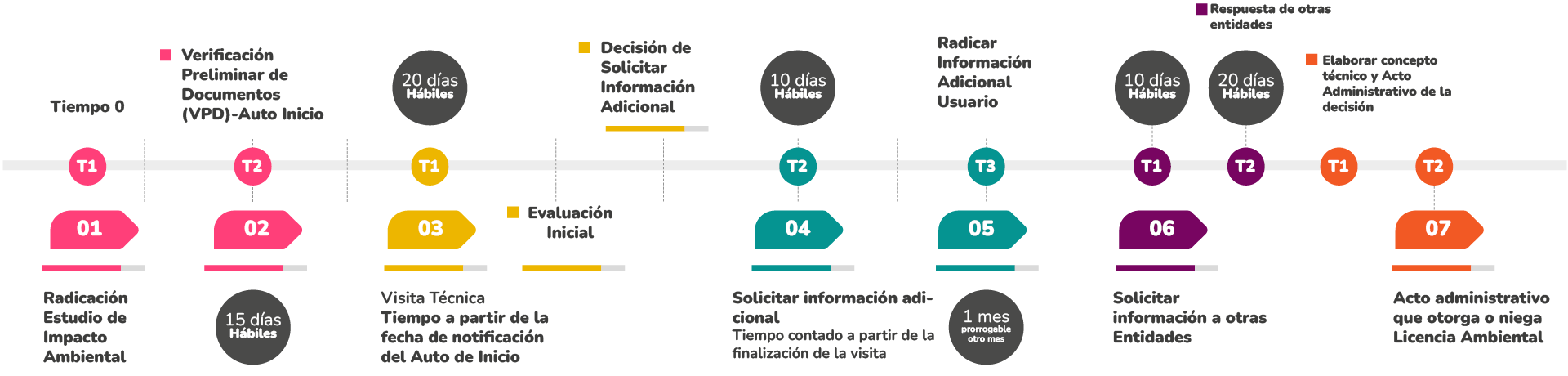
Fuente: Autoridad Nacional de licencias ambientales-ANLA
Environmental Licensing
Decree 1076 of 2015
- Request for terms of reference for environmental studies
- Environmental Alternatives Diagnosis
- Preliminary verification of documents
- Environmental Impact Study
- Environmental License Process
- Transfer of Environmental License
- Transfer of Environmental License
- Minor Changes to Environmental License
- Environmental Public Hearing
- Concept by natural parks system for projects affecting the National System of Natural Parks
- Other
Projects that do not require an environmental license
Withdrawal from Reserves and Protected Areas
Withdrawal from Reserves and Protected Areas
National Authority - ANLA
Regional Authority - CAR
- Withdrawal from National Forest Reserve
- Withdrawal from Regional Forest Reserve
- Regional Protected Area
- Civil Society Reserve
- Other
Forest Utilization
Decree 1791 of 1996
- • Forest Utilization Permit
- Extension or Expansion of Forest Utilization
- Forest Establishment and Management Plan
- Forest Inventory Authorization
Environmental Administrative Proceedings
Decree 1076 of 2015
- Utilization of Natural Resources
- Study of Natural Resources - For which a Study Permit was granted for the Collection of Specimens of Wild Species of Biological Diversity for the purpose of Conducting Environmental Studies.
- Study of Natural Resources - For which a Study Permit was granted for the Collection of Specimens of Wild Species of Biological Diversity for the purpose of Conducting Environmental Studies
- Approval of the Compensation Plan (1%, Biodiversity Loss)
- Other
Land use restrictions
Restriction Criteria for the Implementation of Renewable Energy Electricity Generation Projects and Green Hydrogen Production
Summary of Areas with Different Restriction Criteria for the Implementation of Renewable Energy Electricity Generation Projects and Green Hydrogen Production.
| Región | Área total [Ha] (A) | Áreas protegidas [Ha] (B) | Áreas inundables Fenómeno Niña 2012 [Ha] (C) | Áreas en cercanía de fallas geológicas [Ha] (D) | Resguardos indígenas [Ha] (E) | Consejos comunitarios afro-descendientes [Ha] (F) | Área disponible - excluyendo B, C y D [Ha] (G) | % máximo de área disponible (H) |
|---|---|---|---|---|---|---|---|---|
| 1. Caribe Norte | 8.859.696 | 894.893 | 749.764 | 18.412 | 1.321.838 | 5.012 | 7.196.627 | 81,2 % |
| 2. Caribe sur | 4.367.675 | 1.017.637 | 87.042 | 6.074 | 243.265 | 438.150 | 3.256.922 | 74,6 % |
| 3. Pacífico | 7.540.933 | 723.317 | 83.230 | 8.837 | 1.323.208 | 4.362.553 | 6.725.550 | 89,2 % |
| 4. Andes sur | 7.230.863 | 1.172.000 | 35.283 | 33.512 | 329.731 | 223.994 | 5.990.067 | 82,8 % |
| 5. Andes centro | 10.932.920 | 1.362.583 | 121.308 | 28.847 | 279.174 | 204.029 | 9.420.182 | 86,2 % |
| 6. Andres Norte | 9.463.137 | 1.470.848 | 167.735 | 22.671 | 128.153 | - | 7.801.884 | 82,4 % |
| 7. Orinoquía | 25.356.003 | 2.527.742 | 477.078 | 15.172 | 4.271.616 | - | 22.336.011 | 88,1 % |
| 8. Amazonía | 40.396.247 | 9.877.621 | 270 | 4.459 | 20.386.882 | 2.788 | 30.513.897 | 75,5 % |
| TOTAL | 114.147.474 | 19.046.641 | 1.721.710 | 137.984 | 28.283.867 | 5.236.526 | 93.241.140 | 81,7 % |
Restricción estricta
Condiciones a considerar durante el diseño
Consulta previa requerida
Map of Areas with Different Restriction Criteria for the Implementation of Renewable Energy Electricity Generation Projects and Green Hydrogen Production
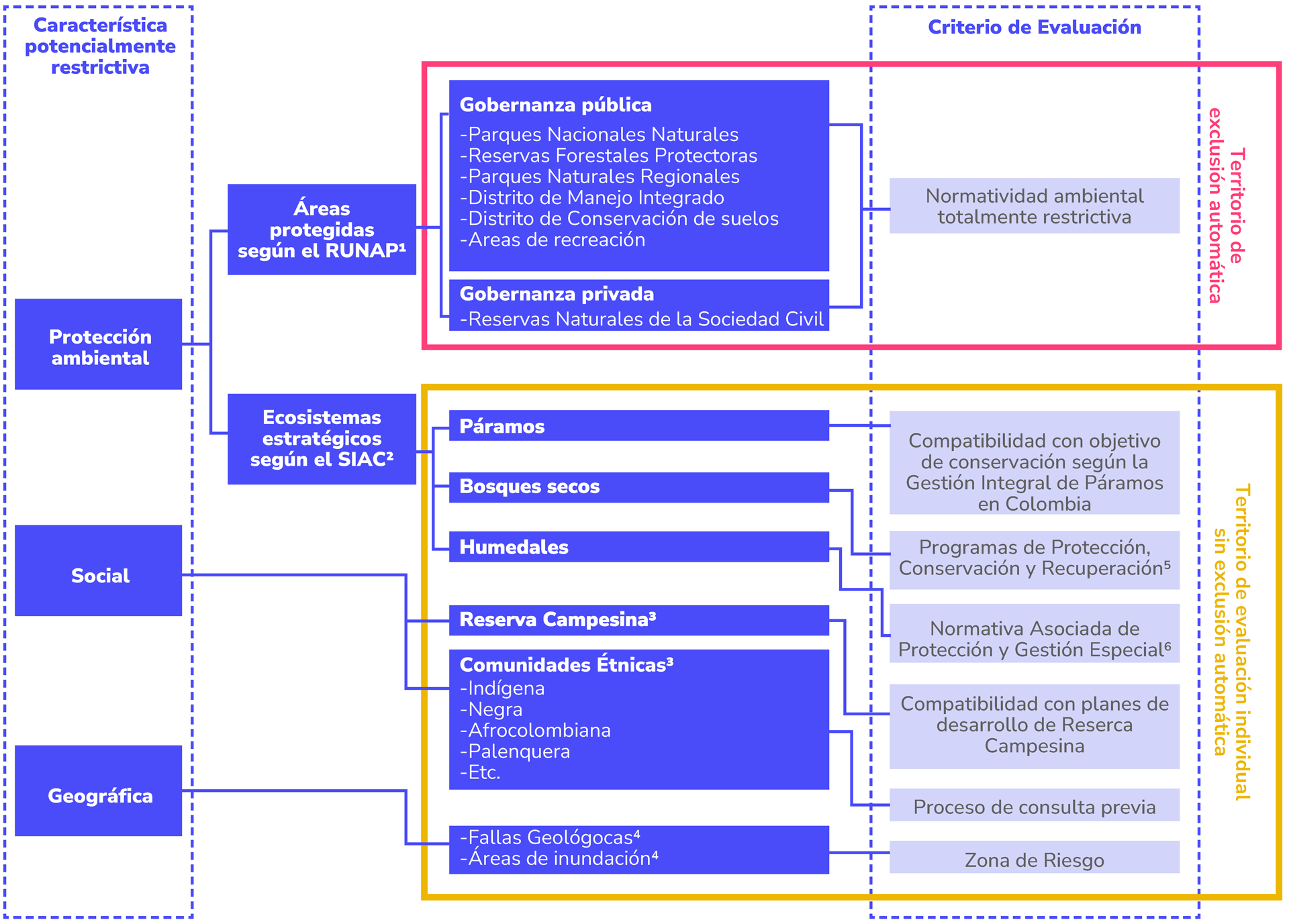
Fuente: GIZ Colombia. Estudio técnico, económico e identificación de hubs de hidrógeno verde en Colombia. 2023.
Map of areas with different restriction criteria for the implementation of renewable energy electricity generation and green hydrogen production projects
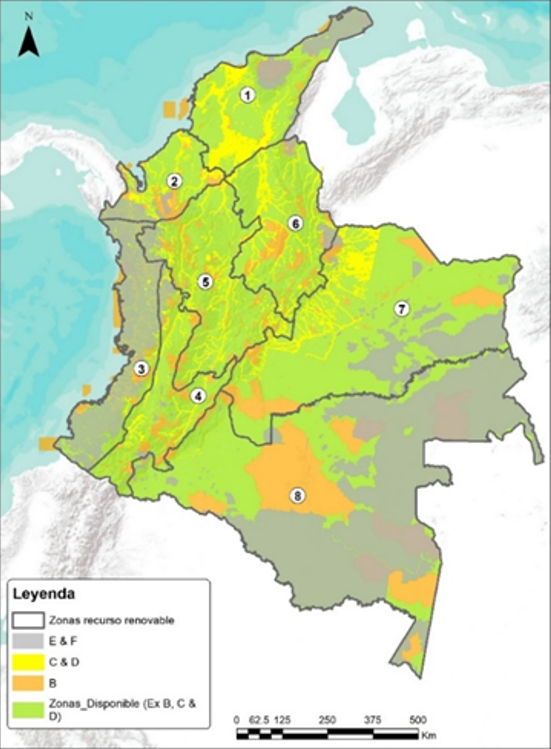
Fuente: GIZ Colombia. Estudio técnico, económico e identificación de hubs de hidrógeno verde en Colombia. 2023.

Construction
Construction
Land Acquisition
- Public Deed and Property Registration
- Certificate of Ownership History
Construction License
Requests to territorial entities:
- New Construction
- Expansion
- Adaptation
- Modification
- Demolition
- Reconstruction
- Fencing
Easement Management
Easement Management - Access Permission
Technical Certificates
RETIE Certification for Electrical Installations
ONAC accredited entities directoryDeclaration of Public Utility
Request for declarationDeclaration of PINE (Priority Interest National Area)
Request for declarationSelf generation and Connection to SIN
Marco normativo
Connection Procedures to the National Interconnected System (SIN)
Administrative proceedings with OR
Resolution 024 of 2015-AGGEPor la cual se reglamentan los aspectos comerciales del mercado mayorista de energía en el sistema interconectado nacional, que hacen parte del Reglamento de Operación
Resolution 174 of 2021-AGPE y GDRegula las actividades de autogeneración a pequeña escala (AGPE), autogeneración a gran escala (AGGE) y generación distribuida (GD)
Disposiciones y procedimientos para la asignación de capacidad de transporte
Resolution CREG 148 of 2021Conexión y operación de plantas solares fotovoltaicas y eólicas en el SDL con capacidad efectiva neta o potencia máxima declarada igual o mayor a 5 MW
Resolution CREG 101-011 of 2022Por la cual se establecen las condiciones para la implementación de la infraestructura de medición avanzada en el SIN
Solicitud de conexión temporal y compartida
Temporary Connection Request
Proceso de conexiones UPMEShared Connection Request
Proceso de conexiones UPME
Operation
Specific requirements related to final product of interest.
- Report on Information for the National Information System for Mining and Energy Sector Projects
- Registration with the network operator as Large-scale self-generator (AGGE) / small-scale self-generator (AGPE)
- Certificate of absence of report for drug trafficking (CCITE) for derivatives such as methanol and ammonia Controlled products and substances
- Certificates for installations in accordance with Colombian Technical Standards for Hydrogen (NTC H2)
- Property Tax, Industry and Commerce Tax, Income Tax Return
- Registration of agents and stakeholders in the Fuel Information System (SICOM-GNCV) and information reporting Registration SICOM
- Institute for Agricultural and Livestock Research (ICA) Registration for Fertilizer Manufacturers Registration for Fertilizer Manufacturers

Decommissioning and Abandonment
Other
- Construction License: Demolition
- Environmental Study for Decommissioning and Abandonment Phase